
ΕΑΝ ΠΡΟΤΙΜΑΤΕ ΤΑ ΕΛΛΗΝΙΚΑ ΠΑΤΗΣΤΕ ΤΗΝ ΣΗΜΑΙΑ ΣΤΟ ΚΑΤΩ ΜΕΡΟΣ ΤΗΣ ΟΘΟΝΗΣ
By Helleniscope’s Editorial Team
Orthodoxy’s core governance is conciliar (synodical), not papal. Authority is exercised “with one another,” not over one another—an ethos captured by Apostolic Canon 34: the first (primate) does nothing without the bishops, and the bishops do nothing without the first. Across history, the Orthodox Church has preserved democratic correctives against errant leadership.
Unlike Papism, where power is centralized in one man, Orthodoxy has preserved a system where even the highest hierarch remains accountable to bishops, clergy, and the faithful people of God. Three primary methods have consistently arisen throughout history:
1. Synodal Deposition (the Bishops’ Act)
In Orthodoxy, the Holy Synod functions as the highest canonical court. When a patriarch gravely violates the faith or canons, the Synod (local or Ecumenical) can investigate, try, vote, and depose.
How it unfolds:
Investigation → formal synodal hearing → vote → proclamation of deposition. Appeals are rare and are typically moral rather than juridical.
Modern examples:
Patriarch Irenaios of Jerusalem (2001–2005) was formally deposed after the East Jerusalem property scandal when the Synod voted him out and elected a successor.
Closer to home, Archbishop Spyridon of America (1999) and Metropolitan Evangelos of NJ (2022) were both removed through a synodal process (although in the case of Archbishop Spyridon, even though he technically resigned, the other Metropolitans [the Synod] had already stated their opposition to him and a vote was forthcoming anyway).
This method represents the bishops acting together as guardians of ecclesiastical doctrine and order.
2. Financial Pressure from Below (the Parishes & Metropolises Act)
Because parishes and metropolises in the Diaspora materially sustain the central Church, widespread withholding of funds functions as a potent bottom-up check.
Case in point: In the late 1990s, opposition to Archbishop Spyridon of America included parishes (and prominent lay leaders such as Archons) cutting off funding to Archdiocesan headquarters (and ultimately to the Patriarchate). This widespread financial rebellion accelerated his resignation and led to his replacement.
Why this matters: In a conciliar system, money follows trust. When clergy–laity confidence collapses, financial pressure often precipitates synodal action.
But a caution: This method is not only a modern-day consequence, stemming from a Church Organization that has adapted to massive budgets, but it is also a double-edged sword. If misused, financial strangulation could be weaponized by lukewarm or heretical factions to undermine a traditional leader simply for being traditional. It should only be deployed when a hierarch is a proven betrayer of the Faith or violator of Canons, and refuses to repent or resign
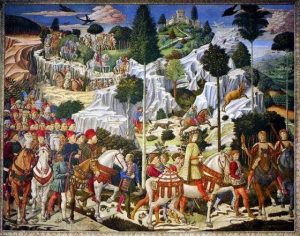
IMAGE ABOVE: Benozzo Gozzoli’s 1459 Journey of the Magi is assumed to portray John VIII Palaiologos at the front and center riding his horse, likely during the pseudo-council of Ferrara-Florence.
3. The Rising of the Faithful (Popular Reception or Non-Reception)
Perhaps the most powerful and ancient corrective in Orthodoxy is the principle of acceptance: the people of God (laos) “accept” or “reject” a spiritual leader and his teachings.
Case Study: Constantinople’s Port, 1440s — The Non-Acceptance of the Union of Florence
In 1439, the Council of Florence proclaimed union with Rome (Laetentur Caeli). When Emperor John VIII Palaiologos and the “Orthodox” delegation returned to Constantinople in 1440, the populace met them with bitterness, rejecting the false union as a betrayal of Orthodoxy.
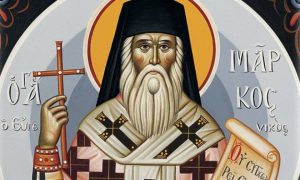
St. Mark of Ephesus, the only bishop who refused to sign at the Council of Florence, became the rallying figure of the resistance.
Unionist bishops were heckled at the docks; Isidore of Kiev was jailed in Moscow for trying to promulgate the decree.
Popular rejection was so strong that the Union was never accepted by the people, despite imperial support.
This event proved the doctrine of “reception”: that Orthodoxy is preserved not by decrees alone but by the living faith of clergy and laity together.
Scriptural & Canonical Roots legitimizing the faithful’s opinion on who should and should not lead them:
Acts 6:3: “Therefore, brethren, select from among you seven men of good reputation, full of the Spirit and of wisdom…”
Exodus 18:21: “Select capable men from all the people—men who fear God, trustworthy men who hate dishonest gain…”
The Canons even stipulate that if the faithful cry “Anaxios!” (Unworthy) during an ordination, the ceremony must halt pending investigation.
Thus, the rejection of the false union at the port of Constantinople was not merely political—it was deeply canonical and traditional. It also serves as a model that can always be followed in times when the faithful are steadfast and commonly united in their displeasure of any ranking member of the clergy.
Why This Differs from Papism
Roman Catholicism centers on papal universal jurisdiction and the authority of unilateral acts. The bishops of the West were tricked long ago into submitting and surrendering their Synodal powers to a “supreme bishop”, and even declaring him to be “infallible”. Orthodoxy, by contrast, binds patriarchal authority within the framework of synodality and reception, despite modern attempts from Constantinople to distort the Synodal tradition with “inaccurate marketing terms” such as “the spiritual leader of 300 million Orthodox” or the scandalous “primus sine paribus” that was sadly published by archbishop Elpidophoros years before he was made an archbishop. In direct contrast to these outrageous “marketing” slogans, modern dialogues (Ravenna 2007, Chieti 2016) underline this difference: in Orthodoxy, no patriarch may unilaterally change doctrine or impose union.
Contemporary Relevance: Is “Union” Being Pursued Again?
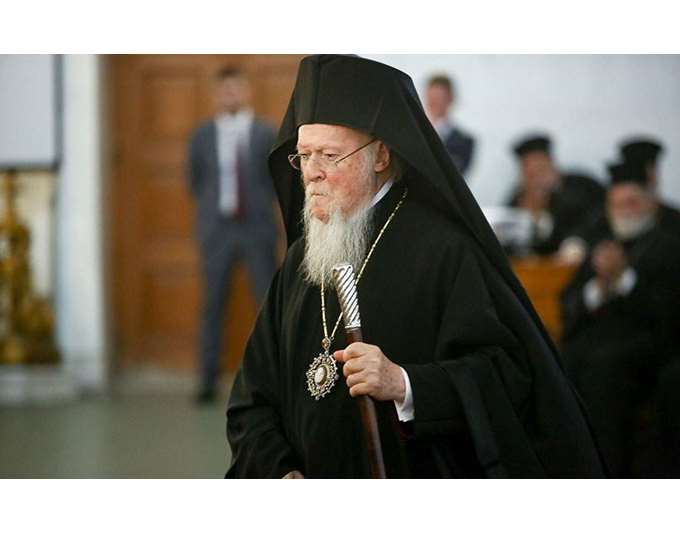
Critics of Ecumenical Patriarch Bartholomew argue that his ecumenical gestures with Rome echo the path to Florence. Indeed, the Patriarch has signed joint statements with popes about “journeying towards unity in legitimate diversity.” Scandalizing videos abound with members of the Synod of Constantinople (and others) bowing down to kiss the hand of the Pope, in direct violation of Canons, and much more. In light of these images, the faithful always remember the Lord’s words in Matt 5-28, and effortlessly recognize the “guilty ones” that have already accepted False Union (committed spiritual adultery) in their hearts.
But Orthodoxy’s system ensures that any official union would require:
Synodal approval,
Material support and cooperation from the faithful, and
Reception by the laos.
Without these, as the 1440s emphatically proved, such efforts cannot stand.
The Present Danger: Bartholomew and Elpidophoros
Patriarch Bartholomew, along with Archbishop Elpidophoros of America, has repeatedly promoted ideas and practices that are alien to the Orthodox Tradition. Chief among these (because the rest of them primarily rely on this one being “accepted”) is the heretical (Papist) claim of “primus sine paribus”—“a first without equals”—which would elevate the Ecumenical Patriarch to a papal role, in direct contradiction to Apostolic Canon 34 and the conciliar ethos of Orthodoxy.
Moreover, both hierarchs have openly aligned themselves with secular ideologies antithetical to the faith (including denial of the Faith with the famous quote “there are many paths to the top of the mountain”, multiple “common prayer” events with heretics), promoting forms of woke activism and even giving tacit blessing to homosexuality—positions consistently condemned by the Holy Scriptures and the Fathers. The Church has never recognized same-sex unions or sexual relations outside sacramental marriage as anything but sin. Yet, Bartholomew and Elpidophoros attempt to cloak such practices in the language of “inclusion” and “diversity,” thereby blessing what God Himself has condemned.
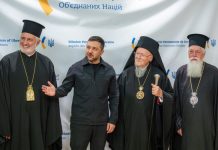
Finally, their unilateral and uncanonical recognition of the schismatic Ukrainian “autocephaly” has fractured Orthodoxy, leading to one more schism and disrupting communion with entire Local Churches. In pursuing political agendas over ecclesiastical unity, they have not only betrayed the conciliar foundation of the Church but also repeated the errors of Florence: seeking union or innovation without reception.
The lesson of history is clear. Whenever patriarchs or archbishops attempt to impose heresy—whether through papal pretensions, political compromise, or moral laxity—the faithful retain the right and duty to resist, to withhold support, and to proclaim “Anaxios!”
August 29, 2025, n.stamatakis@aol.com www.helleniscope.com
DISCLAIMER: The views and statements expressed in this article constitute constitutionally protected opinions of this author.
TO SUPPORT HELLENISCOPE OR BECOME A SUBSCRIBER, LINK HERE!!
===================
Citations
Apostolic Canons, esp. Canon 34.
OrthodoxWiki — “Patriarch Irenaios of Jerusalem.”
Al Jazeera — “Greek Orthodox Patriarch sacked.”
The Christian Century — reporting on Patriarch Irenaios.
Los Angeles Times — “Greek Orthodox Archbishop Ousted Amid Disputes.”
National Catholic Reporter (1999) — coverage of Spyridon’s resignation.
Tampa Bay Times — “Church votes to oust Spyridon.”
ArchbishopSpyridon.gr — archival reflections.
Encyclopedia Britannica — “Council of Florence.”
Orthodox Church in America — “St. Mark of Ephesus.”
New Advent Catholic Encyclopedia — “Council of Florence.”
EWTN — background on Florence.
Assembly of Bishops — “Conciliarity and Primacy.”
Vatican archives — joint declarations with Patriarch Bartholomew.
el.wikipedia.org/wiki/Μητροφάνης_Β΄ — on Patriarch Metrophanes II.
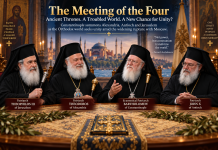








But will the faithful do anything. Will they continue to accept all of the above mentioned heresy?
Hopefully they wake up and start opening their mouth – while they keep their pockets closed…
Yes, that is the solution. Let’s hope.
In my case, I do not accept it. And I do not contribute a lot to the church, but their finances are solid and the church is growing. But when I brought up with my priest the terrible decisions of the patriarch we are under, who is the worst patriarch I can think of in present time, he doesn’t want to talk about it. He doesn’t want me to bring up anything wrong that Barto is doing. In other words, complete silence. He wants to talk to me about anything else but this. And most of the people of our church are completely silent or have no knowledge about it. NONE! I can’t find one person that follows what he is doing. They just do not know. Even about the situation in Ukraine, they blame Zelenski and have zero knowledge about the Tomos. It’s shocking!
God knows my position, and I guess that’s enough for now. And I do go to other churches, this is no longer my main church. Since I have children in school I will continue to go here on and off because it is the closest. But after that, if things don’t improve, I will stop going. The commemoration of his name hurts my ears. It just seems so strange to commemorate someone that has caused so much pain and forgets to mention Christ but talks about trees instead. I spoke to a few people about it and it is like they are numb. Or don’t care. Really scary! But if we are ever to take sides, I know the side that I will be on. Like the mother of this OCU “bishop” who took the Great Schema in the UOC!
https://spzh.eu/en/news/87900-mother-of-ocu-bishop-takes-the-great-schema-in-a-uoc-monastery
What would it take to remove the patriarch? In 2022, the Alexandrian Patriarchate formally condemned the ideology of “Russian World” as heretical and broke communion with Patriarch Kirill. Patriarch Bartholomew has also concurred that “Russian World” is a heresy, although he has not broken communion with the Russian Church over this. The Volos Declaration of 2022, signed by 1,600 Orthodox theologians and clerics, also declared the ideology of Russian World as heresy. So while there is formal accusation and condemnation of the Russian World heresy, there currently still isn’t enough support to remove the patriarch.
Have any churches formally declared Patriarch Bartholomew to be a heretic? None. Not even the Russian Church has formally done so. The reason that the Russian Church broke communion with Patriarch Bartholomew is solely because of a territorial dispute.
A territorial dispute? Whitewashed words! Old Bart is tight with US State Department. He did their dirty work for them .
Joseph,
It is illogical to claim that a man who burns down a building is the “victim”.
Long before 2022, a “tomos” was issued that resulted in the breaking of Communion between Moscow and Constantinople. Anything after the fact is posturing and BS. Time and time again we have proven that in both 1992 and 1998 Bartholomew himself signed letters to Moscow affirming that Philaret and his followers were considered “deposed/defrocked” AND that the entire situation in Kiev was Moscow’s jurisdiction. At the same time, Patriarch Theodore of Alexandria didn’t have to commemorate Epiphanios (which expanded the schism and triggered the Russian Exarchates in Africa), except that Theodoros reportedly needed the monetary infusion from the Greek government and elsewhere that were being held as “leverage”…again an example of “Simony”, which you very well know invalidates any ordinations that are “recognized”. You alwasy conveniently side-step these important details with the propaganda angles you present. Bottom line: When it is Bartholomew who caused the problem (Schism) long before 2022, inventing a lame excuse and trying to blame someone else is not going to fly, no matter how many “signatures” you collect…
As for the 1600 “theologians” at the “Volos conference”, there is a guy from the village in Greece who loves to attend these “theological” conferences, but who many years ago got into a debate with me and disclosed that he was first an Atheist, then a Communist, and finally a “theologian” because that’s what his degree was in and that’s what he was “hired” as in the Greek school system in order to “earn his daily bread”. You can imagine how he has been poisoning young minds for many years…If this guy (or any of the thousands like him that the corrupt Greek educational system has produced since the 1980s) is one of the 1600 signatures you referenced, how legitimate is that signature anyway? Besides, all those signatures in the pseudo-Council of Ferrara didn’t stick against the test of time, did they?
Also sticking to Volos…would the same 1600 “theologians” eagerly sign the obvious, that in the Diaspora of North/South America and Australia, and even Western Europe there are multiple Orthodox bishops from different autocephalous Churches claiming Canonical jurisdiction of the same “episcopates”, in direct violation of the Apostolic Canons? What does “Russian World” or “Constantinopolitan World” mean in this light? And speaking of Western Europe, why is it that there are Orthodox Churches in France, Belgium, the UK, etc. when once upon a time Constantinople recognized that those were jurisdictions that belonged to the Synod of Rome? If Constantinople can create a “Constantinopolitan World” after a “Great Schism”, it is historically consistent that Moscow can create an Exarchate in Africa after Patriarch Theodore stupidly betrayed Metropolitan Ounoufry who he visited only a few weeks prior to unilaterally commemorating Epiphanios on that fatal day in that liturgy in Cairo…are the 1600 signatories of Volos not aware of history? I’m sure they are, but there’s obviously something else going on there…
And by the way, there are 150 MILLION Orthodox in Russia, with thousands of priests, and hundreds of bishops…according to the Canons, you only need 3 bishops to continue a Church, because they can keep ordaining bishops. Given that the Schism with Moscow has nothing to do with Moscow changing its dogma, but rather with Constantinople recognizing deposed Schismatics and Uniates (with “Simonic incentives” from Poroshenko as reported in media sources of the time), Orthodoxy in Russia is here to stay for many years, and attempts to call it something that it is not won’t stand the test of history. The only way this Schism will end is if Constantinople changes its Rome-looking Uniate path, and corrupt hierarchs in other jurisdictions stop commemorating Epiphanios.
Also, should we remind everyone of Bartholomew’s claim to “all of China” after Hong Kong was annexed in 1997, even though Ecclesiastical history teaches us that there was already a Russian bishop (and saint) in SHANGHAI long before 1997? The friction with Moscow over geographical jurisdiction was fueled by Bartholomew a long time ago.
As a final thought, this is a moment to remember that the Church is very careful historically upon whom She bestows the title THEOLOGIAN. We know of St. John the Theologian, St. Gregory the Theologian, and even St. Symeon the new Theologian. Not even St. John Chrysostom was bestowed that title, and nowadays we have every “Joe” getting a piece of paper from a College or University and daring to call themselves “theologians” in a pompous and arrogant manner, contrary to the Church’s historically wise limitation of use for this term, even if they are self-declared Atheists like in the case of the guy from my village, and many others like him (in Greece especially).
The perpetrator can’t be portrayed as the victim, Joseph…anyone who is capable of reading your response isn’t stupid enough to consume your obfuscating propaganda.
Markos, the ideology of Russian World might not be much different than the promotion of Hellenism, except that ever since 2014 it has been backed by violence and weapons. Nobody is currently promoting Hellenism with violence and guns, but the ideology of Russian World has been the basis of the war in Ukraine ever since 2014. Ideology plus weapons equals war.
I would surmise that’s why the Turks have been very careful about suppressing Hellenism. The message of the Turks to Greece is clear: don’t get any ideas, don’t even think about it. Of course the Turks have no problem promoting a neo-Ottoman ideology and even by flaunting it with their military. “Neo-Ottomanism” is an actual threat.
An ideology isn’t necessarily heresy, though, except when it uses Christianity as an ideology to serve its aims. I think we can all agree that “Christian Zionism” is a heresy for this very reason. “Primus sine paribus” has certainly been accused of being heresy here and elsewhere, but those accusations typically don’t evaluate the real primacy that exists within any autocephalous church. Yes, when a primatial bishop votes in the Holy Synod, he is first among equals. However, only the primatial bishop has the right to call a local council. In that sense, he is first without equals.
The “150 million Orthodox Christians in Russia” (more like a 100 million according to estimates) is certainly impressive, but so are the 1.4 billion Roman Catholics in the world. The number of adherents doesn’t validate the corresponding ecclesiology, neither with Roman Catholics nor with the Russian Church. The Russian Church has parishes everywhere outside of Russia, on every continent on earth, including Antarctica. How is that even canonical?
Joseph this sentence of your comments proves how wrong you are: An ideology isn’t necessarily heresy, though, except when it uses Christianity as an ideology to serve its aims.
Especially in light of Bartholomew’s sermon on Indiction which promotes the political ideology of environmentalism instead of the gospel… See our today’s post.
Joseph,
I know you always feel compelled to “say the last word”, but the latest string of sentences you present make no contextual sense, are another weak atempt to obfuscate, or perhaps indicate that you really didn’t comprehend the words to which you are tyring to respond.
Bottom line:
1) Bartholomew caused a Schism with Moscow when he issued the tomos, ignoring the pleas of multiple autocephalous Churches to do so. Even today, multiple autocephalous Churches still don’t recognize Epiphanios.
2) After the “Breaking of Communion” with Rome in 1054, it is clear that Constantinople incrementally established bishops in Roman Catholic territories such as France, Belgium, etc. Isn’t this a “Constantinopolitan World” that the 1600 signatories of Volos should also agree to? Constantinople “showed the example” of what happens after a Schism, and now that Theodoros of Alexandria stupidly commemorated Epiphanios and Moscow ceased Communion with him and some others from his Synod (not the entire Synod yet), why is Theodoros playing “crybaby” and “victim” with the Russian Exarchates in Africa, when he was the perpetrator that idiotically chose to support the hostile move by Bartholomew? It’s like the kid that comes back from school with a big bruise, crying to his mommy that the “big, strong kid that I stole lunch [Ukrainian jurisdiction] from hit me hard)…action and reaction, buddy…if you don’t like the reaction, don’t perform the action that provokes it.
3) So what makes the “Constantinopolitan World” in Western Europe any more legitimate than the “Russian World” in Africa in this case, but especially in the Diaspora, where multiple bishops claim jurisdiction over the same cities and territories for over a century now, in direct violation of existing Canons?
You can’t insist on defending the perpetrators and portray them as victims, period. The readers of Helleniscope (and elsewhere) aren’t stupid.
As I’ve stated before, Joseph, you never cease to be entertaining!
Thank you, Nick, for researching and presenting to us this valuable information, I say valuable because this information ultimately affects our salvation. We are sanctified in the Church, and the Church needs to preserve and the teach the faith handed down through the ages.. And if the bishops go bad, and they change the teachings of the Church so that she will no longer be the depository of truth, those bishops must be deposed.
Your research, Nick, makes clear that we the laity can be a check on the bishops’ malpractice and heretical teachings.
Voithia Mas.