


source – estianews.gr — Main Editorial
Cyprus “declared” an EEZ — what are we afraid of? With the delimitation announced by Nicosia with Lebanon, it completed the legal procedures, ignoring the threats of the “Blue Homeland.” Greece, hostage to the theory of a “hot incident,” still does not exercise its rights.
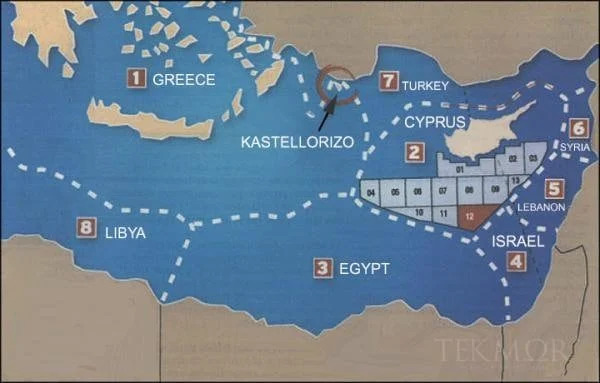
With a 23-year delay, the Government of Lebanon ratified the agreement on the delimitation of maritime zones with Cyprus, reshaping the geostrategic landscape of the Eastern Mediterranean. Estia had already highlighted the achievement of this agreement days earlier, in its October 25th issue. The agreement had been reached in 2007, at a time when Cyprus was entering similar delimitation agreements with Egypt and Israel.
It was among the first countries to implement the provisions of the International Law of the Sea, as soon as the parliaments of the participating states ratified the Montego Bay Convention (which established the UNCLOS framework). Cyprus, therefore, hurried to seize the opportunity — an opportunity Greece has let pass by. Yet Greece should have been the first country to sign an EEZ delimitation agreement with Cyprus, securing the rights of the two Greek states in the maritime zones of the Eastern Mediterranean. It did not — and the question is: Why? What is it afraid of?
With the ratification of the delimitation agreement with Lebanon, Nicosia closes one chapter of pending issues, at least regarding the zones south and east of the island. To the west, where delimitation with Greece should have been signed, there is a gap. A “black hole.” Greece, moreover, has not even declared an EEZ, being content with the fact that the Greek and Cypriot continental shelves are contiguous (though still without a delimitation agreement), as are the Athens and Nicosia FIRs and their related zones of responsibility for search and rescue.
The crucial point is that the 23-year delay in Lebanon’s ratification of the agreement was due to intense Turkish pressure on the country. The fact that Beirut has now decided to proceed constitutes a real defeat for Turkey’s regional ambitions. It means that, in this case, Turkey’s consistent policy of enforcing faits accomplis through the threat of violence has failed. And this should serve as a “lesson” for Athens, which seems to operate under the constant fear of a “hot incident” with Turkey — a fear that prevents it from taking the bold decisions needed to defend national interests in the wider region.
The fact that Greece has not declared an EEZ (it has only done so partially, alongside the delimitation agreements with Italy and Egypt) shows that Athens continues to live under a peculiar state of captivity — one that allows Turkey to impose its positions. The rhetoric used to “justify” this stance is tellingly similar: “We avoided war,” said Kostas Simitis after the Imia retreat. “We avoided a crisis,” said Giorgos Gerapetritis after the Kasos retreat.
Yet Cyprus shows us that there is another way — the way of persistence in national rights. In this case, it created faits accomplis and cornered Turkey, at a moment when Ankara was preparing to sign a delimitation agreement with its “friend,” Syria’s al-Assad. Determination to the goal brings results. Cyprus succeeded by pursuing a consistent maritime delimitation policy, one that began during the late Tassos Papadopoulos’s tenure.
Why, then, does Athens hesitate?
















Εμποδίζει την και από την Ελλάδα ανακήρυξη ΑΟΖ το ΕΛΙΑΜΕΠ ή/και άλλα παγκόσμια υπόγεια μυστικά Κέντρα συνεργαζόμενα με το πολύκλαδο & βαθύρριζο ΔΕΝΔΡΟ του αρχαίου πολύμορφου ΚΑΚΟΥ, που απειλεί τον Ελληνισμό & την Ορθοδοξία ;;;
Έως πότε ;;;