


By Helleniscope’s Editorial Team
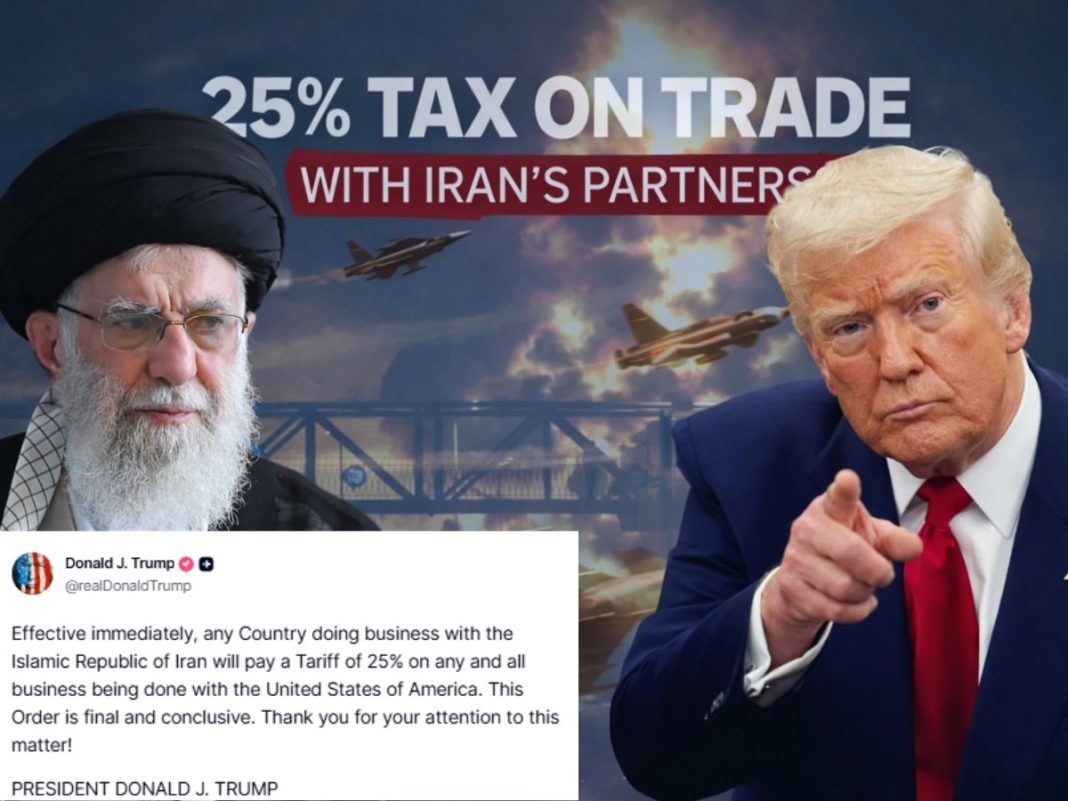
Donald Trump’s sudden order imposing a 25% tariff on any country doing business with Iran is not deterrence. It is a public admission of strategic failure — a loss of control repackaged as economic punishment.
The move did not emerge from preparation or leverage. It is the product of accumulated frustration: failed energy ambitions in Venezuela, stalled coercion of Iran, erratic diplomacy over Greenland, technological setbacks involving China and Russia, and the growing realization that U.S. threats no longer guarantee compliance.
The announcement itself revealed its weakness — abrupt, maximalist, legally vague, and globally indiscriminate, with no clear enforcement mechanism. This is not a strategy. It is a reaction. Once again, Trump plays poker, while his opponents play chess. Can someone tell him that chess was invented by the Persians?
Venezuela: The Energy Lever That Never Existed
Venezuela was supposed to anchor Trump’s hemispheric energy strategy. Instead, major U.S. oil companies declared the country uninvestable and refused to deploy capital, regardless of political pressure.
The consequences were significant. Without Venezuelan production, Washington lost a key alternative energy lever against Iran and Russia. Moscow, meanwhile, expanded its footprint in Caracas, while the U.S. was left issuing threats it could not enforce economically. The Chavista regime appears more defiant, not weaker.
When capital refuses to follow power, power is already eroding. Trump further damaged his credibility by claiming — after Maduro’s arrest — that he had coordinated with oil executives before and after the operation, a total fiction, a lie.
Iran: When Sanctions Lose Force
Iran has not collapsed under pressure. It has adapted. Despite years of sanctions, Tehran continues to trade — primarily with China, but also with states that have learned to navigate U.S. restrictions.
Unable to isolate Iran directly, Washington has shifted to punishing third countries wholesale. This concedes the core problem: U.S. coercive tools are losing precision. Historically, such indiscriminate pressure accelerates resistance rather than compliance. In view of the fact that the BRICS are now much bigger in terms of GDP than the G-7, the “tariff policy” is bound to backfire fast.
Greenland: Noise Without Gain
Renewed talk of Greenland reinforced a pattern of overreach — maximal ambition paired with minimal execution. The rhetoric alienated allies while producing no tangible advantage.
Power projection without coalition support is not projection; it is exposure. Any renewed push on Greenland appears driven less by strategy than by the need to salvage credibility after repeated geopolitical setbacks.
China: The Asymmetric Response Washington Ignores
The most dangerous assumption behind the tariff order is that China must respond symmetrically. It does not.
China dominates global rare earth mining, processing, and refining — materials essential to U.S. defense systems, aerospace, semiconductors, EVs, and advanced manufacturing. This is not a trade imbalance; it is a structural choke point.
Beijing needs no public retaliation. Licensing delays, regulatory reviews, or environmental inspections could quietly disrupt U.S. supply chains within weeks. Markets would react faster than diplomats. And they will force Trump to backtrack as he did a few months ago.
Losing the Information Edge
Trump’s frustration also reflects eroding technological leverage. Iran’s ability to blunt Western communications strategies — reportedly with Chinese and Russian assistance — undermines a core assumption of modern pressure campaigns: that information dominance ensures political control. Iran was able to jam Starlink, and yesterday, Trump was looking for Elon Musk to provide a technical solution. When this failed, acting emotionally, he imposed the 25% tarriffs!!
Russia Advances While Washington Threatens
As Washington escalates economically, Moscow advances geographically. Reports of advanced Russian missile systems being positioned in Cuba and Venezuela are deliberate signals: the Western Hemisphere is no longer uncontested.
Tariffs do not counter missiles. They distract from them.
Why the Tariff Strategy Will Fail
It cannot isolate Iran without alienating U.S. partners
It hands China asymmetric leverage through rare earths
It accelerates de-dollarization and trade realignment
It traps the U.S. in a credibility dilemma: escalate or retreat
Once supply disruptions hit defense contractors and manufacturers, domestic pressure will force de-escalation. When that happens, the tariff threat collapses — and its limits become unmistakable.
The Strategic Reality
This is not the return of American dominance. It is the exposure of American weakness.
Trump’s tariff order does not reshape the global order. It confirms that economic intimidation without supply-chain control is obsolete — and that America’s rivals are prepared, patient, and increasingly confident.
Power today belongs not to those who shout first, but to those who control the bottlenecks.
January 12, 2026, n.stamatakis@aol.com www.helleniscope.com
DISCLAIMER: The views and statements expressed in this article constitute constitutionally protected opinions of this author.
TO SUPPORT HELLENISCOPE OR BECOME A SUBSCRIBER, LINK HERE!!
Sources
Reuters – Trump tariff announcement on Iran
https://www.reuters.com/world/middle-east/trump-says-countries-doing-business-with-iran-face-25-tariff-2026-01-12/Financial Times – Secondary sanctions and Iran trade dynamics
https://www.ft.com/content/c266f78d-1b53-4aa5-99ff-1726a5126a23Reuters – U.S. oil companies and Venezuela investment refusal
https://www.reuters.com/world/americas/us-oil-companies-venezuela-uninvestable-2025-12-18/Reuters – Trump advisers and Greenland discussions
https://www.reuters.com/world/trump-advisers-discussing-options-acquiring-greenland-us-military-is-always-an-2026-01-06/U.S. Geological Survey – Rare earth supply dominance
https://www.usgs.gov/centers/national-minerals-information-center/rare-earths-statistics-and-informationZeroHedge – Tariffs on countries doing business with Iran
https://www.zerohedge.com/markets/trump-imposes-25-tariff-any-country-doing-business-iran-effective-immediately














Recalling one of my major studies in Labor Economics and the politics of Macroeconomics I want to share with you my thoughts:
Tariffs can have complex effects on a country’s economy, including the USA’s, especially when dealing with countries that have exchange rates linked to the Iranian rial.
Trump has not realized that some foreign countries can strengthen their ties with other global powers, such as China.
Here are some ways tariffs can advantage the USA in this context:
By imposing tariffs on imports from countries with favorable exchange rates, the USA can make foreign goods more expensive, thus encouraging consumers to buy domestically produced goods. This can help protect local industries and jobs. The question is whether American industry is ready to replace imported products with its own. Of course if this product is shoes , fabric or cosmetics from France consumers will deny to buy but if this product is medication imported from France necessary for the health system of the usa consumers it will harm the patients. Still some breast cancer medication is imported from either Italy or France.
Trump is a real estate developer who thinks only in terms of building skyscrapers. Still, his family, in particular his daughter Ivanka, won’t be able to export her products if the countries she exports retaliate with their own tariffs against the USA’s exported goods.
Trump is thinking of a short-term deal when he threatens to impose tariffs with his sick logic on every country that has deals with Iran , unless he treats every other country according to his preferences.
Oh mon Dieu!