


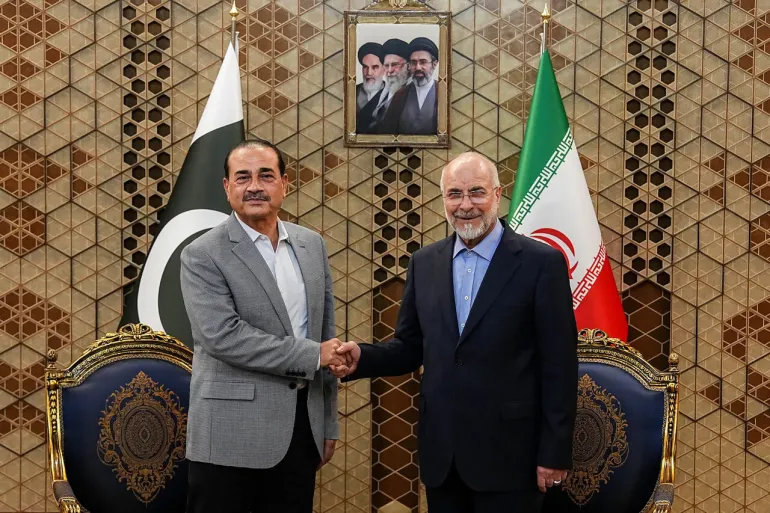
PHOTO: Iran’s Parliament Speaker Mohammad Bagher Ghalibaf shakes hands with Pakistan’s Army Chief Field Marshal Asim Munir during their meeting in Tehran on May 23, 2026
EDITOR’S NOTE (Nick Stamatakis). As I wrote these lines, Pakistani Field Marshal Asim Munir was in Tehran to discuss several issues, chief among them whether, and under what terms, Iran would join Pakistan, Turkey, and S. Arabia in the so-called Mecca Accords. According to the excellent analysis below by former CIA analyst Larry Johnson, Russia and China were on board with such an eventual agreement months ago. Multiple reports say Mr. Asim Munir was in touch with President Trump before his visit to Iran. It looks like the stars are aligning for a new regional security architecture in the Middle East that will not include a dominant American presence. Anyway, the Pentagon has already determined that it is not “cost-effective” to rebuild the many bases (almost all) Iran destroyed in the Gulf…
With the US marginalized – if not completely out of the Middle East – one has to wonder about the enormous repercussions for Israel… Not to mention the “petrodollar” – whose fate now hangs in the balance. My personal prediction: Neither Russia nor China prefer an abrupt transition to a new “reserve currency system”. Instead, they have already prepared the foundation for the US Dollar’s coexistence with the yuan and other currencies. And both China and Russia have established cross-border transaction systems alternative to SWIFT and the dollar… It looks like we are looking in the next few decades to a gradual elimination of USD’s monopoly and the coexistence of multiple cross-border systems…
====================
Not an Islamic NATO: The Mecca Agreement Is Building the Post-American Security Architecture — and Iran Is About to Walk In

The Western commentariat filed the Mecca agreement under a comfortable heading. When Saudi Arabia, Turkey, and Pakistan signed the Makkah Joint Defense Agreement on August 7 — an armed attack on one to be treated as an attack on all — the reflexive label was “Islamic NATO,” a Sunni bloc, three of the Muslim world’s largest militaries welded together by sectarian identity. That reading was obsolete almost before the ink dried. What is actually taking shape is not a Sunni alliance against Iran. It is the first load-bearing beam of the post-American security architecture that Russia and China have been calling for — and Tehran is about to walk through the door.
The language was not accidental, and it did not originate in Riyadh. On April 27, in St. Petersburg, after meeting Iranian Foreign Minister Abbas Araghchi, Vladimir Putin called for a new security architecture in the Persian Gulf. One week later, on May 5–6 in Beijing, after his own meeting with Araghchi, Chinese Foreign Minister Wang Yi said essentially the same thing — that Beijing supports the establishment of a regional peace and security architecture in which the regional countries themselves participate, safeguard common interests, and pursue common development. Araghchi, for his part, told Putin that Iran supports a new post-war regional architecture that can coordinate development and security.
Note the two nouns Araghchi paired: development and security. That pairing is the tell, and I will return to it. Russia has floated a collective security concept for the Gulf since 2019; Lavrov reiterated it on February 28, 2026 — the very day the war began. The consistent aim is a multilateral, regionally led framework that replaces the American defense umbrella over the Gulf, installs Moscow and Beijing as the guarantors alongside the regional states, and — crucially — treats Iran not as a threat to be contained but as a legitimate pillar of the order. As Araghchi paraphrased his Chinese hosts: Iran after the war is a different country, its standing improved, a new era of cooperation ahead.
Hold that blueprint in mind, and look again at Mecca.
The first pillar
The Makkah agreement was signed in wartime, and that context is everything. Nearly six months into the war that began on February 28, Saudi Arabia had absorbed repeated missile and drone strikes, and confidence in Washington’s willingness to actually backstop Gulf security in real time had visibly cracked. Out of that erosion came a treaty binding Pakistan — the only nuclear-armed Muslim state, with an arsenal near 300 warheads — to Turkey, which fields NATO’s second-largest army, and to Saudi Arabia, the Gulf’s financial anchor and custodian of Islam’s holiest cities. Nearly 1.4 million active personnel and some $124 billion in combined annual defense spending, joined under a single mutual-defense formula for the first time since the Baghdad Pact era.
The signatories were careful to call it purely defensive and, in Erdogan’s words, open to other countries. Ankara floated Egypt; Dhaka signaled interest. The Western analysts who noted that all three members are American partners — Turkey in NATO, Pakistan a major non-NATO ally, Saudi Arabia the largest buyer of U.S. arms — and concluded the pact was therefore no threat to Washington, made the same error as those who called it a Sunni NATO. They read the founding membership and missed the trajectory. A pact “open to others,” signed by states that have lost faith in the American umbrella, in the middle of a war against Iran that Iran is surviving, was never going to stay a three-member Sunni club.
Here is what the public analysis has not yet caught up to, and what I can report from firsthand sources. On Monday morning, Field Marshal Asim Munir — Pakistan’s chief of army staff and the real architect of Islamabad’s regional strategy — is in Iran. The subject of his talks is Iran’s accession to the Mecca agreement as its fourth member.
Read that slowly, because it detonates the entire “Islamic NATO” framing. A mutual-defense pact led by the Sunni heavyweights of the Muslim world, admitting Shia Iran, is not a sectarian bloc. It is the opposite: the dissolution of the very Sunni-Shia fault line that Western strategy has exploited for a generation. And what remains, once Iran is inside, is not “NATO” of any confessional flavor. It is precisely the inclusive, regionally led architecture that Putin and Wang Yi described — a framework in which Iran sits as a legitimate pillar rather than a quarantined enemy. Mecca provided the structure. Tehran’s entry supplies the meaning.
It does not stop at Iran. Bahrain — a Gulf monarchy that hosts the U.S. Fifth Fleet — is, I am told, negotiating with Pakistan to join the military alliance with Saudi Arabia. Consider the weight of that. The Gulf state most physically entangled with American naval power is hedging toward the regional bloc. Each such accession chips another brick out of the American security order in the Gulf and mortars it into the new structure rising beside it.
Recall Araghchi’s pairing — development and security. A security architecture that does not carry an economic circulatory system is a paper alliance. The Mecca pact is acquiring one, and here again Pakistan is the hinge.
Islamabad — with China standing behind it, through the CPEC investment and the Gwadar port that already give Pakistan its overland corridors into Iran — has decided to deepen its economic integration with Tehran dramatically. Munir is negotiating a tenfold increase in Pakistan-Iran trade over three years. That is not a rounding error in a sanctions regime. It is a demolition of one.
And it is, to put it plainly, a slap across the face of Scott Bessent. The US Treasury Secretary has spent the war promising the toughest sanctions in history, an unprecedented campaign to isolate Iran economically and starve it into capitulation. He is now watching a nuclear-armed American ally, financed and backed by China, move to multiply its trade with the very country he vows to strangle — trade that will run on yuan and barter and regional currencies, outside the dollar clearing system his sanctions depend on. The security architecture and the economic architecture are being built in the same motion, by the same man, on the same trip. Bessent’s isolation strategy is being answered not with defiance in words but with integration in deeds.
There is a deeper irony here, and it is worth naming, because it indicts a generation of American strategy. For decades Washington treated the Sunni-Shia divide as an asset to be worked — arming and tolerating Sunni militants as instruments against Shia Iran, from the redirection of the Bush years through the Syrian war. The entire logic depended on the divide staying open. Now the principal Sunni powers of the region — Saudi Arabia, Turkey, Pakistan — are themselves closing it, folding Iran into a shared framework of defense and commerce. The wedge Washington spent twenty years driving is becoming the foundation of a bloc that answers to Moscow and Beijing rather than to Washington. That is blowback of the highest order: not a weapon turned on its maker, but a fault line the maker relied upon, sealing shut.
An opinion is not worth much if it cannot survive its own qualifications, so here they are. Munir’s trip is a negotiation, not a signing; Iran’s accession and Bahrain’s are, as of this writing, in motion, not concluded, and either could stall. The Sunni-Shia trust deficit is real and decades deep — Gulf monarchies have long feared Iranian subversion, and a defense treaty does not erase that overnight. Prior mutual-defense pacts in the region, including the Saudi-Pakistani agreement of September 2025 and the older GCC arrangements, never once triggered a NATO-style collective response, and this one may prove as declaratory as those. All three Mecca signatories retain deep, live relationships with the United States and will not sever them lightly; much of this may be hedging rather than a clean break. And the firsthand reporting above describes intentions and negotiations, which are not yet treaties.
But direction is not the same as arrival, and direction is unmistakable. Every one of these hedges points the same way — away from the American umbrella and toward a regional order underwritten by Russia and China.
The Mecca agreement was sold to Western audiences as a Sunni bloc and dismissed as a club of American clients. It is neither. It is the first pillar of the security architecture Putin and Wang Yi named this spring after sitting with Iran’s foreign minister — a regionally led, Russia- and China-backed framework that folds Iran in as a legitimate power and pushes the United States out as the indispensable one. When Asim Munir walks into Tehran on Monday to discuss Iran’s membership, and negotiates a tenfold expansion of trade in the same breath, he is not conducting two errands. He is laying two courses of the same wall. The Americans built their Gulf position on keeping Sunni and Shia apart and keeping the dollar in the middle. Both pillars are being pulled at once — and the structure going up in their place was drawn in Moscow and Beijing.













Strangely, Larry Johnson doesn’t mention the State of Israel in all this, but Israel is undoubtedly the main problem and reason why the “Makkah Joint Defense Agreement” exists.
https://www.ynetnews.com/article/h16pfyvuml
You need to qualify your statements – seriously. This is a very complicated foreign policy issue. Neither Turkey nor Pakistan can “control” Iran for the “graces” of Israel. I will mention one thing: that Pakistan’s eternal enemy, India, has a very close relationship with Israel… Where does this fit? I will not even touch the even more complex Turkey-Israel relationship, where despite all the mutual “explosions of rage” and the threats of war, the business exchanges are still enormous, and the oil flows to Israel from Azerbaijan, through the Turkish port of Ceyhan, have never been interrupted.
Joseph, geopolitics is a very difficult math/chess game and needs a lot of study before you make statements like that.
Maybe I’m reading too much into the photo, but Erdogan’s body language tells me he’s not 100% on board. He’s probably trying to find a way to play both sides against the middle. The Israelis pay him good money for all that Syrian oil, if you know what I’m saying…
You are right – Erdogan will never go to war with Israel or anyone, including Greece. In the Eastern Mediterranean, everyone knows the Turkish military isn’t as strong as the numbers suggest. Greek Air Force and Navy can disable Turkey in a matter of hours – and so can the Israeli Air Force. Overall, the Turks see themselves as the heirs of Byzantine diplomacy, and they truly are (not to mention the many Greeks that, since the Fall of Constantinople to today, yes today, serve in the Turkish Foreign Ministry – it’s the definition of “Phanarriots” that we so widely use). Finally, we should not forget that Turkey stayed neutral in both World Wars – and this is no accident.
Good points. I guess I shouldn’t be surprised that there are still (crypto?) Greeks in the Turkish foreign ministry.
That said, I can easily see Israel doing a false flag which will draw Turkey into war against Greece, NATO be damned.
These are descendants of older generations of Turkish diplomats – although I am sure they are conscious of their descent and origins. Especially in this age when a big part of Turkish citizens are doing their DNA tests and are “surprised” to find out their Greek, Armenian, or Kurdish descent.
A false flag is in the daily playbook of Israeli leadership, as we have seen. They managed to have Trump escape Ankara in another plane, as we saw recently…
Even the Atlanticists/globalists admit America is ceding the Middle East: https://www.foreignaffairs.com/united-states/end-american-middle-east-iran-marc-lynch