


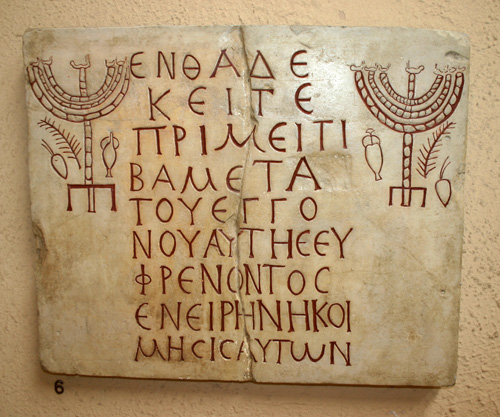
If Hellenic culture, language, and philosophy had not been dominant during Christ’s time, Christianity would have remained a Jewish sect, as numerous other sects were. It would not have attained the worldwide reach that the faith eventually achieved. Here is a summary of how that came about.
The Greeks first mentioned the Jews in the 300s B.C., before Alexander’s conquest of Palestine. They praised the Jews as brave, self-disciplined, and philosophical.
After Alexander’s death in 323 B.C., Palestine came under the governance of the Hellenistic kingdom of the Ptolemies, based in Egypt. The Jews were allowed considerable religious and political freedom. In 198 B.C., Palestine was conquered by the other great Hellenistic kingdom, the Seleucids, ruled by King Antiochos III.
The Seleucids granted even greater autonomy to the Jews, even allowing them to govern themselves according to the Torah. Most cities in Palestine had already attained a high level of Hellenistic culture, with the more advanced citizens even influenced by Greek religious customs—an influence that helped prepare the ground for the later acceptance of Christianity.
By the early 200s B.C., Hellenic influence was so strong that it is thought that if the Seleucids had not begun interfering with Judaism, the Jews of Palestine might have become as integrated as the Jews of Alexandria. The Alexandrian Jews were almost completely Hellenized, though they continued to study the Torah.
The interference of the Seleucid monarchs created a revolutionary mindset among non-Hellenized Jews. Yet Hellenic influence remained so dominant that many priests of the Temple were Hellenists. It was so strong that a Temple priest named Jason, who had established Jerusalem as a Greek city offering Greek higher education, was overthrown by another priest, Menelaus (both bearing Greek names), who was an even stronger proponent of Hellenism.
Menelaus sought to abolish Jewish practices such as circumcision and dietary laws. He influenced the Hellenistic king of the time, Antiochos IV, to forcibly Hellenize the remaining Jews. All the kings of the dynasty bore the name Antiochos—hence the name of the city Antiochia, which still exists. Though Antiochos IV had previously granted special privileges to the Jews, he was swayed by Menelaus and initiated a harsh anti-Judaism policy.
This was intolerable to the traditional, non-Hellenized Jews. A priest named Mattathias, along with the Maccabees, revolted against Menelaus and the Hellenizers. After a protracted and violent struggle—during which the traditionalists even kidnapped the sons of Hellenizers and forcibly circumcised them—the Maccabees prevailed.
Eventually, the Maccabees and the Hellenizers reached a balance. Although differences remained, they tolerated each other. Greek influence continued to gain power and prestige, reaching its peak under King Herod (yes, the one we know), who built a Greek theater, amphitheater, and hippodrome in and around Jerusalem.
By the time Christ was born, Hellenistic influence had reached its zenith. This is essential to understanding the later development of the greatest faith in the world.
Next article: the continuation of this fascinating story of the turbulent years at Christ’s birth and beyond His crucifixion and resurrection—years that explain the how and why of our faith.
Comments and corrections are welcome.














Oscar Wilde in his book DE PROFUNDIS writes that Jesus preached in Greek too, and has several pages of passages Jesus spoke in Greek!
Το άρθρο γράφει:
with Greek inscription (for Primitiva and her nephew Euphrenon.
Διόρθωσις: ΕΓΓΟΝΟΣ στην μαρμάρινη επιγραφή = grandson , not nephew!
I don’t know why Helleniscope didn’t give this article top billing, but Thank You Lambros
for writing.
Interesting, Hellenism reached its zenith by the time Christ was born…
Very enlightening!
From Vespers of Christmas:
“When Augustus reigned alone on the earth, the many kingdoms of mankind came to an end; and when You became man from the pure Virgin, the many gods of idolatry were destroyed. The cities of the world passed under one single rule, and the nations came to believe in one God. The peoples were enrolled by decree of Caesar; we the faithful were enrolled in the name of the Godhead, when You became man, O our God. Great is your mercy. Lord, glory to you.”
Christ was born at exactly the right time to enable the Gospel to spread most fully throughout the world.
Interestingly enough, the eyes of the image of the man on the Shroud of Turin have Roman coins. A Greek funerary practice.
The cultural tradition of the Greeks, Hellenism was the prevalent worldview before and during the growth of early Christianity. Hellenism was based in the belief that human beings are the ultimate source of truth and authority in the universe. Thankfully, Saint Paul and the apostles, disciples spread the holy words of our Lord and Saviour Jesus Christ, in Greece. Frankly, the best thing that happened to the Greeks! We are truly the chosen people…..Greece is where the body of Christ, the Orthodox church was arduously cultivated and grew; and that’s not by chance.