


ΕΑΝ ΠΡΟΤΙΜΑΤΕ ΕΛΛΗΝΙΚΑ ΠΑΤΗΣΤΕ ΤΗ ΣΗΜΑΙΑ ΣΤΟ ΚΑΤΩ ΜΕΡΟΣ ΤΗΣ ΟΘΟΝΗΣ
In the Ionian Sea, natural gas lies in relatively shallow waters, while oil has historically surfaced naturally. AN IMPRESSIVE FACT: Oil from Zakynthos was known from antiquity, and it DOES NOT need refining!!! This Fact was known a century ago, when Greek warships filled their engines directly from Zakynthos and ran without any problems at all!! Watch Sofianopoulos at the video in this article at 6:70
By Helleniscope’s Editorial Team
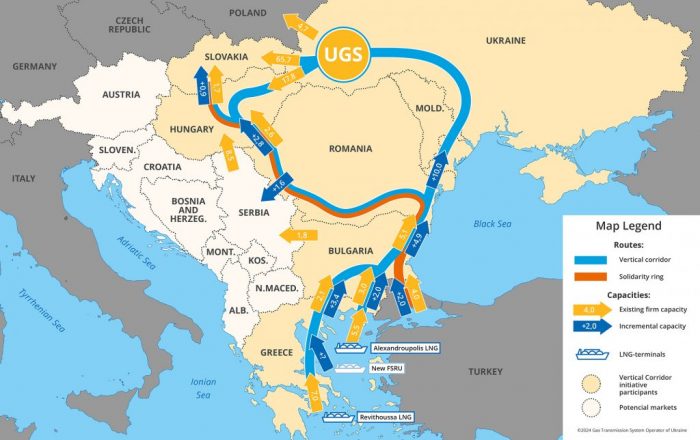
Debates around the so-called “vertical corridor” have become central to Europe’s post-2022 energy strategy. Diplomats and officials present it as a northbound artery—gas flowing from Greece through Southeast Europe to Ukraine—reducing Russian leverage and reinforcing Western alignment. American and Israeli officials frame it as security. Greek governments present it as proof that Greece is becoming an energy hub.
Yet in all these discussions, one crucial question is largely avoided:
Why is Greece’s own natural gas and oil potential almost entirely absent from the equation?
The corridor is conceived as a system for transporting other people’s energy—LNG from the U.S., other global markets, while Greece is reduced to a transit state. This omission is not trivial; it is structural.
Formally, Greece has moved. Agreements with Chevron and ExxonMobil were finally signed after decades of delay. Offshore blocks south of Crete and in the Ionian Sea are now on the map. But progress is painfully slow. Exploration timelines extend far into the future, urgency wanes, and political will appears performative rather than strategic.
This hesitation is especially puzzling given what is already known. In the Ionian Sea, natural gas lies in relatively shallow waters, while oil has historically surfaced naturally. Around Zakynthos, Katakolon, and other locations, hydrocarbons are not an abstract theory but a long-observed reality. This is not extreme deepwater speculation; it is postponed exploitation.
==========
There are numerous incidents to suggest that an “invisible hand” cut those pioneers, like the Greek brilliant entrepreneur Sotiris Sofianopoulos, who in 1977 tried and did start pumping oil out of Zakynthos, only to see his permit taken away a few months later… Who are the powers that don’t want Greece to become a hydrocarbon producer? (You can watch him in this video to describe his efforts – English subtitles).
AN IMPRESSIVE FACT: Oil from Zakynthos was known from antiquity, and it DOES NOT need refining!!! This Fact was known a century ago, when Greek warships filled their engines directly from Zakynthos and ran without any problems at all!! Watch Sofianopoulos at 6:70
=========
If the vertical corridor is truly about security of supply and strategic autonomy, then domestic production should be its backbone. Greek gas would make the corridor cheaper, more resilient, and more credible. It would also neutralize the most damaging criticism: that the project locks Europe into structurally high energy costs.
Instead, the corridor is implicitly designed to channel LNG—often American, sometimes Israeli, much more expensive than Russian pipeline gas—into Europe and Ukraine. Political arguments are strong; market signals are not. Recent capacity auctions attracted minimal or zero interest. Traders are indifferent to geopolitics. They respond to prices, and prices are unforgiving.
This exposes a deeper contradiction. Greece remains one of Europe’s most heavily indebted countries. Few states have stronger incentives to monetize domestic resources responsibly. Even moderate production could improve the trade balance, lower energy imports, generate fiscal revenues, and strengthen Greece’s negotiating position inside the EU.
Yet Greece consistently chooses the role of facilitator over producer—absorbing geopolitical risk while exporting value creation.
Defenders cite environmental concerns, long timelines, and Europe’s energy transition. But these arguments ring hollow when Europe simultaneously promotes LNG imports and new infrastructure elsewhere. Gas will remain part of Europe’s energy mix for decades. The resistance to Greek production is less about climate and more about political convenience.
An uncomfortable asymmetry also persists. Western partners strongly support the corridor, but there is limited clear evidence of substantial non-European public investment. The costs and risks fall mainly on European consumers and industries, while Greece is urged to wait, even though it holds resources that could anchor the system itself.
This raises an unavoidable political question: why do Greek governments, across administrations, move so slowly in allocating resources that could enhance sovereignty, competitiveness, and fiscal stability? Is this caution, ideology, regulatory paralysis, or deference to external interests more comfortable with Greece dependent than empowered?
This is not an argument for reckless drilling. It is an argument for coherence. A strategy that celebrates transit infrastructure while sidelining domestic production is incomplete by design. Energy security built solely on expensive imports is fragile. Geopolitics that ignores economics does not endure.
Until Greece’s own gas and oil are treated as part of the system rather than a footnote, the vertical corridor will remain a grand strategic narrative built on everyone’s energy—except Greece’s.
January 31, 2026, n.stamatakis@aol.com www.helleniscope.com
DISCLAIMER: The views and statements expressed in this article constitute constitutionally protected opinions of this author.














Prompted by your timely article, I want to share some thoughts.
Perhaps one reason Greece’s natural resources have not been exploited — while also respecting the heartfelt legacy of the late Sofianopoulos — is bureaucracy, the complicated licensing procedures, the delays we all experience when dealing with the Greek state apparatus, and which do not seem likely to change in the next five years. Why would a monopolistic resource-extraction company invest in such an honorable state? When the Germans were building the Venizelos airport, they employed Greek workers and supervisors who were supposed to check the quality and the weight of the sand to be used, until they received information that fraud was taking place; by conducting a secret inspection they caught the swindlers in the act, transporting smaller quantities of sand in trucks with beds, and had to change personnel to avoid being cheated. I do not mean to flatter the Germans — who still owe us reparations and unpaid loans from the Occupation — but that is a separate matter. A little seriousness wouldn’t hurt.
Continuing, I would say that perhaps the investors themselves fear legal and regulatory obstacles, and that this, in turn, becomes even more discouraging. Could the same domestic political system be afraid of the costs of new explorations? We produce only modern sophists who show off vast foreign experience. One of the best biscuit factories with massive exports reportedly exploded due to a propane leak, sending so many female workers to their deaths.
On top of all this come the beasts of the world, who have names, and international companies that may prefer imports that serve their own investments and commercial flows.
Perhaps the X monopolistic gas or oil resource-extraction company faced reality in the tax system, which the eternal unionized tax inspectors may not be able to handle, who serve first the interests of their own oligarchs. See the shame of shames, OPEKEPE, and the other disgrace of an Eurovouleytria and a commissioner in Europe, both corrupt, who tried to expose Greece, not to mention the hundreds of others who have embarrassed us.
Not only do “some not want it,” but real obstacles — economic, political, and social — make the exploitation of resources difficult or undesirable for certain actors. If Greece wants to change course, it needs a clear strategic framework: strict environmental rules, attractive yet fair fiscal/contractual incentives, fast, transparent permitting, and a plan that combines economic benefits with a commitment to the energy transition.
Thank you for the hospitality.
Sevasti Boutos