
TO READ THE ORIGINAL ARTICLE IN GREEK FOLLOW THIS LINK ΕΠΙΣΚΟΠΟΣ και ΠΟΛΙΤΙΚΗ ΔΙΚΑΙΟΣΥΝΗ 13.1.26
By Father Anastasios Gotsopoulos
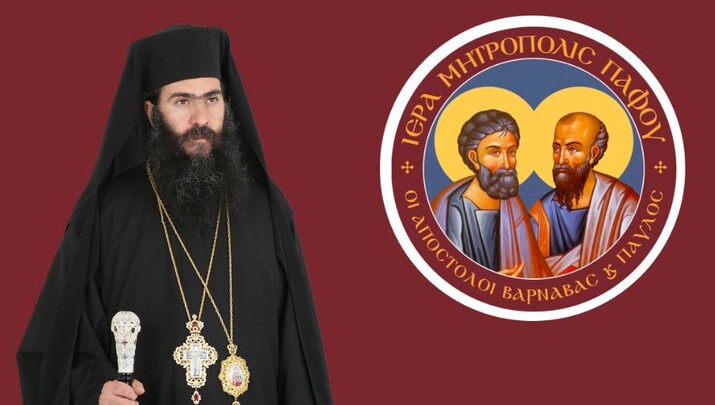
With his letter dated 8 January 2026 to the Holy Synod of the Church of Cyprus, Metropolitan Tychikos of Paphos informed it that he intended to appeal—and indeed, as reported in the press, did appeal yesterday—to the Civil Courts in order to secure a fair trial in his case.
In response to this letter, the Holy Synod stated in its communiqué of 8 January 2026 that it had “examined his unacceptable actions from the standpoint of ecclesiastical ethos in appealing to the Civil Courts, something which is condemned by the Holy Canons,” and called upon him to “withdraw his appeal or his intention to appeal to the Civil Courts.”
a. Do the Holy Canons prohibit this? NO!
The question, therefore, arises: Is Metropolitan Tychikos’s appeal to secular Justice “unacceptable from the standpoint of ecclesiastical ethos” and contrary to the Canons? Do the Holy Canons prohibit a cleric from appealing to the civil courts? Does the Charter of the Church of Cyprus prohibit recourse to secular justice?
First of all, it should be noted that the communiqué (8 January 2026) neither substantiates nor justifies the claim that recourse to secular courts is supposedly “unacceptable from the standpoint of ecclesiastical ethos.” Nor does it refer to—or even mention, as it should have—any Holy Canon on which it bases the claim that recourse to secular justice is uncanonical.
It is true that there are canons which do not allow clerics to disregard ecclesiastical justice, to refuse to make use of it, and to contrive through the political authority (“the Emperor”) to be tried exclusively and solely by Civil Courts and not by ecclesiastical ones. In such cases, the cleric is subject to canonical penalties. The relevant Holy Canons are: Canon B-6 (“having despised what was decreed as stated above”), Canon D-9 (“let him not abandon his own bishop”), Canon Antioch-12 (“having disregarded these things”), and Canon Carthage-15 (or Carthage-14) (“having renounced the ecclesiastical court”).
Does Metropolitan Tychikos’s appeal fall under the case prohibited by the Holy Canons? Obviously not!
From the texts published so far, and especially from his appellate petition of 5 June 2025 to the Ecumenical Patriarchate—his most official document—Metropolitan Tychikos HAS NEITHER DENIED NOR DOES HE DENY the JURISDICTION of the ECCLESIASTICAL COURTS. On the contrary, he asks to be tried by a genuine Ecclesiastical Court, with all the safeguards provided by the Holy Canons and the Charter of his Church. He asks to be tried properly and truthfully by the organs provided for by ecclesiastical procedural law (the Investigative Committee, the Ecclesiastical Prosecutor, and the Holy Synod, lawfully constituted as a court).
Consequently, the provisions of the above-mentioned Holy Canons do not apply in the case of Metropolitan Tychikos.

b. Do the Holy Canons permit this? YES!
Moreover, there exists Canon 104 of the Council of Carthage (in the Rudder, Carthage-115), which precisely concerns the case of Metropolitan Tychikos:
“It has pleased [the Council] that whoever requests from the Emperor a judgment of public courts shall be deprived of his own rank. But if he requests from the Emperor an episcopal judgment, let nothing hinder him.”
The Canon provides that if any cleric asks the Emperor to refer his case to be judged not by an ecclesiastical but by a civil (“public”) court, he is to be deprived of his priestly rank. If, however, he asks the Emperor that the case be referred to an ecclesiastical court (“episcopal judgment”), he is not to be hindered and is certainly not penalized.
Interpreting Canon Carthage-104 (Rudder-115), Zonaras notes that if a cleric approaches the Emperor seeking judgment by public, that is civil and governmental courts, he shall be deprived of his rank (i.e., deposed). But if he approaches the Emperor seeking an episcopal court—namely, an assembly of bishops convened by imperial command to adjudicate—he shall not suffer any penalty.
Balsamon follows the same interpretive approach, stating that the present Canon is clear: clerics who renounce the ecclesiastical court and seek from the Emperor that their cases be judged by public, that is, civil, judges are to be deposed. But those who obtain imperial commands so that they may be judged by bishops are not to be harmed.
Aristenos interprets likewise, stating that a bishop or cleric accused of offenses, who renounces the ecclesiastical court and seeks secular judges from the Emperor, shall be deprived of his rank.
Finally, Saint Nikodemos the Hagiorite, in the Rudder, interpreting Canon Carthage-104 (Rudder-115), writes that any bishop or cleric who asks the Emperor to have his case judged in civil courts is to be deposed; but if he asks the Emperor for an ecclesiastical tribunal—namely, that bishops be gathered by imperial command to examine his case—then he shall not be penalized as having done something improper. For all Ecumenical and Local Councils were gathered in this manner, that is, by imperial command.
Closely related to Canon Carthage-104 (Rudder-115) is Canon Carthage-15 (Rudder-14), which also makes the imposition of penalties conditional on whether the cleric “renounces the ecclesiastical court and wishes to be cleared by public courts.”
However, as already noted, Metropolitan Tychikos not only does not refuse but repeatedly emphasizes that he wishes to be tried by an ecclesiastical court, provided that the procedural guarantees of the Holy Canons and the Charter are observed.
In his letter of 5 September 2025 to the Ecumenical Patriarch, Metropolitan Tychikos wrote that if it is deemed necessary for the complaints to be examined, he asks that his case be referred back to the Church of Cyprus for a just judgment, obliging it to respect the procedural guarantees of the Holy Canons, the Charter, and international conventions on fair trial. Alternatively, if the Patriarchal Synod itself wishes to judge the substance of the complaints, he asks that specific persons and witnesses—both for the prosecution and the defense—be summoned and examined, so that the Holy Synod may acquire clear and complete knowledge of the groundlessness of the accusations and be assisted in its final decision.
In other words, Metropolitan Tychikos not only does not refuse but persistently asks to be tried by an ecclesiastical court, provided that the canonical requirements for a fair trial are observed.
c. And the Charter allows it as well!
Furthermore, the Charter of the Church of Cyprus provides that the Cypriot secular justice system may review ecclesiastical judges in the exercise of their duties. Specifically, Article 48 (Appendix B II of the Charter) provides that an ecclesiastical trial is repeated “if a substantial breach of judicial duty has occurred in relation to the specific trial, established or strongly indicated following judicial examination before an ecclesiastical or state judicial authority, even if this did not result in the conviction of the judge.”
From an analysis of this provision, it follows that the Charter of the Church of Cyprus allows the “state judicial authority,” that is, secular Cypriot justice, to examine whether a “substantial breach of judicial duty” occurred in an ecclesiastical trial. If such a breach is established or strongly indicated, the ecclesiastical trial is repeated.
One can therefore understand the concern of the Archbishopric of Cyprus should the Supreme Court of Cyprus wish to examine whether a “substantial breach” occurred in the procedure of 22 May 2025, by which Metropolitan Tychikos was declared deposed.
It is obvious that Metropolitan Tychikos’s use of this possibility, which the Charter itself provides, does not constitute a canonical offense. Nor does it constitute an insult to the Church of Cyprus or an undermining of its self-governance; on the contrary, it protects the Body of Christ from unjust judgments by the leadership. An affront to the dignity and self-governance of the Church arises when ecclesiastical leaders believe that their manifestly unjust judicial decisions against their subordinates are beyond review.
Especially when the Patriarchal Synod itself (17 October 2025) accepted the main reasoning of Metropolitan Tychikos’s appeal and found procedural “omissions”—essentially grounds for nullity of the procedure—who will restore ecclesiastical order when the competent ecclesiastical leaders refuse to do so? Article 48 exists precisely to enforce this restoration of ecclesiastical order.
Finally, of particular interest is Circular No. 2300/9.10.1981 of the Hierarchy of the Church of Greece, which, with great courtesy and tact, urges clerics to avoid resorting to secular courts and to confine themselves to appeals before the Holy Synod. Nevertheless, the Hierarchy does not completely prohibit recourse to secular justice, nor does it impose canonical penalties. It notes that, although one might argue that this deprives clerics of a lawful right enjoyed by every Greek citizen, it does not wish to deprive them of their right to have their cases judged at a higher level. Rather, its deep desire is that they resort to the Supreme Ecclesiastical Body, the Holy Synod, which is capable of judging their cases accurately and restoring any injustices committed.
Had these principles been applied in the Church of Cyprus over the past six months, there would have been no reason for Metropolitan Tychikos to “ask the Emperor (i.e., Cypriot Justice) for an ecclesiastical tribunal,” that is, for bishops to be gathered by his command to judge the case according to the applicable provisions. Because this does not exist in Cyprus, Metropolitan Tychikos was compelled to appeal to “Caesar,” to secular Cypriot justice, requesting a fair ecclesiastical trial—and for this reason, according to the Rudder, “he shall not be penalized as having done something improper.”
Conclusion
The Holy Canons prohibit clerics from disregarding ecclesiastical justice, from refusing to be tried by ecclesiastical judicial bodies, and from contriving, through secular authority, to be judged by secular courts. On the contrary, the Holy Canons allow clerics to seek the assistance of political authority in order to be tried by ecclesiastical courts in accordance with the Holy Canons and relevant ecclesiastical provisions (e.g., the Charter).
Finally, the Charter of the Church of Cyprus provides for the secular justice of the Republic of Cyprus to remedy injustices committed by ecclesiastical judges by judicially reviewing their conduct in a specific trial. If a “substantial breach of judicial duty” is established or strongly indicated, the trial is repeated.
Of course, we cannot prejudge or know the outcome of an appeal to the civil courts. What we do know very well, however, is that ecclesiastical history has shown that Saint John Chrysostom died far from his see, deposed, exiled, defrocked, and excommunicated—yet he remains throughout the centuries the great Chrysostom. Along with him were those few who supported him, persecuted, harassed, deposed, and excommunicated by the then all-powerful and brazen ecclesiastical authorities of Constantinople, Alexandria, and Antioch.
For the final word in the Church always belongs to Christ Himself.
Thankfully.
Anastasios Gotsopoulos
Presbyter