

By Eleni Phufas-Jousma
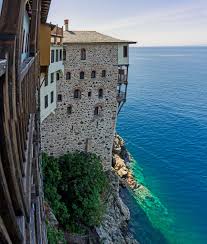
On the easternmost finger of Halkidiki in northern Greece, where entry is controlled by checkpoints and permits, but life within its borders remains beyond the reach of the modern world, lies Mount Athos—a self-governing monastic republic, traditionally understood to be under the protection of the Virgin Mary, where time is not managed, but sanctified. For more than a thousand years, its monasteries have persisted in a way of life that the contemporary West has not merely forgotten but, in many ways, rejected.
That is why the film Where Are You, Adam? is not simply a documentary. It is a quiet contradiction—a glimpse into a life of repentance, lived in the long shadow of Adam’s fall.
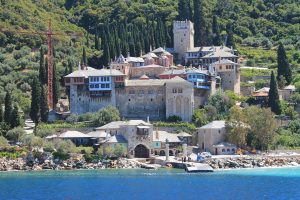
The film does not begin with grandeur, but with death. At Dochiariou Monastery, an aged monk, moving with deliberation and care, prepares a small grave for a cat on the monastery grounds. There is no sentimentality, no attempt to elevate the moment—only attention. The earth is turned, the body is placed, the task completed with a quiet dignity that suggests that nothing, however small, falls outside the scope of prayer.
It is a tone the film does not abandon. The same sobriety—free of display, free of evasion—extends to the life of the monastery itself, and even to the passing of its spiritual father, the late Archimandrite Gregorios.
At one point in the film, he speaks through the camera with disarming frankness, even with tears, of his fear that he may never see paradise. He speaks, too, with concern for what lies beyond his own life—of a world pressing in, and of the possibility that even Athos is not untouched. It is not said with alarm, but with the same sobriety: a recognition that no place, however set apart, is entirely beyond struggle.
There is no performance in the moment—only a humility that unsettles more than any certainty could. And if such a fear can be spoken by a man of his life, it leaves little room for the easy assurances to which the rest of us are accustomed.
And when this hidden world was brought out of Athos and into the life of the Church, it did not feel foreign. At Saint Stephen Serbian Orthodox Church in Lackawanna, NY, the film was received with a seriousness rarely afforded to anything labeled “film” today. The parish priest, Father Branislav Golic, welcomed it not as a spectacle, but as a witness. The faithful watched not as consumers, but with a kind of recognition, something in it was already known to them, though seldom seen.
Filmed within the walls of Dochiariou Monastery, a century-old brotherhood whose life reaches back to the earliest generations of Athonite monasticism, the film offers what modern media almost never captures: reality without intrusion. Not commentary, not narrative imposition, not the restless need to explain—but the simple, demanding rhythm of prayer, labor, silence, and obedience. The monks labor not only in prayer, but in stone—repairing walls, reinforcing foundations, preserving what might otherwise collapse. The film offers no commentary, yet the contrast with the instability beyond those walls is unmistakable.
This is precisely what makes “Where Are You, Adam” unsettling.
For decades, even when Mount Athos has been filmed, it has been framed—edited into something digestible, aestheticized, or reduced to spiritual tourism. The camera, in such cases, does not reveal; it translates—and in translating, it diminishes.
Here, something else has happened.
The filmmakers were not so much granted access as they were, over time, received. In a culture accustomed to immediacy, it is worth noting that filming at Dochiariou Monastery required not negotiation, but time—nearly a decade of it—under the discernment of its late abbot, Archimandrite Gregorios.
That distinction matters. Mount Athos does not open itself to curiosity. It responds, if at all, to humility—and to a willingness to see without seizing.
That this film exists at all is therefore remarkable—not because it shows Athos, but because Athos, in some guarded measure, has allowed itself to be seen.
That is the world this film refuses to soften.
Personal access to this world is itself rare. Even a brief stay requires permission that is neither assumed nor easily granted. I was reminded of this when my husband—though not an Orthodox Christian at the time and the descendant of Protestant pastors—was permitted to spend a week within another Athonite monastery, Mylopotamos. What he encountered was not an “experience,” but a life: ordered, demanding, and entirely uninterested in accommodating the expectations of the outside world.
This was not the work of a passing observer. Director and cinematographer Alexander Zaproshchenko and producer Arch Deacon Oleksandr Plyska spent years returning to Mount Athos—not to capture it, but to wait, until they were, in some measure, received. Zaproshchenko’s camera does not assert itself. It watches—patiently, almost shyly—until it seems to disappear, allowing what is before it to remain undisturbed.
The film offers no argument, and yet it challenges everything: our assumptions about time, about work, about what it means to live with purpose rather than distraction. In an age defined by exposure, it presents a life built on concealment—not as deprivation, but as freedom.
Where are you, Adam? is the first question posed to fallen man. It is also, perhaps, the only one that still matters. In a world saturated with noise and self-assertion, the life depicted at Athos stands as a quiet but uncompromising reply: here is where man is when he is no longer hiding—from God, from silence, or from himself.
The film offers no answer. It leaves only the question:
Where ARE YOU, Adam?
———–
For inquiries: Screenings of the film are arranged privately, in keeping with the wishes of the late Archimandrite Gregorios. Those interested in hosting or attending a showing may contact the filmmakers through the film’s official website.
BELOW YOU CAN SEE THE OFFICILA TRAILER









🌃 Sad that film is not coming to New York…
It looks very impressive.
For the record:
It’s not just on Mount Athos — “some” womens’ Orthodox Monasteries likewise prohibit males on property… but do allow priests for services —
while others, accept All visitors.
Any prohibitions are for spiritual reasons/ascesis.
It’s possible so why not? Screenings of the film are arranged privately and those interested in hosting or attending a showing may contact the filmmakers through the film’s official website. If your church sponsors the film it’s very possible the producer will stop by.
https://denpeirazei.com/
With respect to all Orthodox martyrdom:
Historically, if our mythology hides the truth about our ancestors, the Hellenes (first identified by Homer), the Athos peninsula and the surrounding thousands of acres were rural, full of trees and greenery, where the goddess Artemis, sister of Apollo, used to hunt. At that time, the Hellenes appreciated women more than we do today. Their pantheon included six goddesses.
Today, Panagia, the mother of Jesus — who was later recognized by Orthodox Christian witnesses as closest to her son — protects all the men who visit the monasteries and this beautiful place of isolation and ascetic life. Athos is its own state within the country’s administrative regions (νομοί).
Mythology is just that —
myth. Unbelievable you compare holy Athos to your whining feminism that women were not appreciated. Spare us.
We have Theotokos as role model – we don’t need your Artemis.